

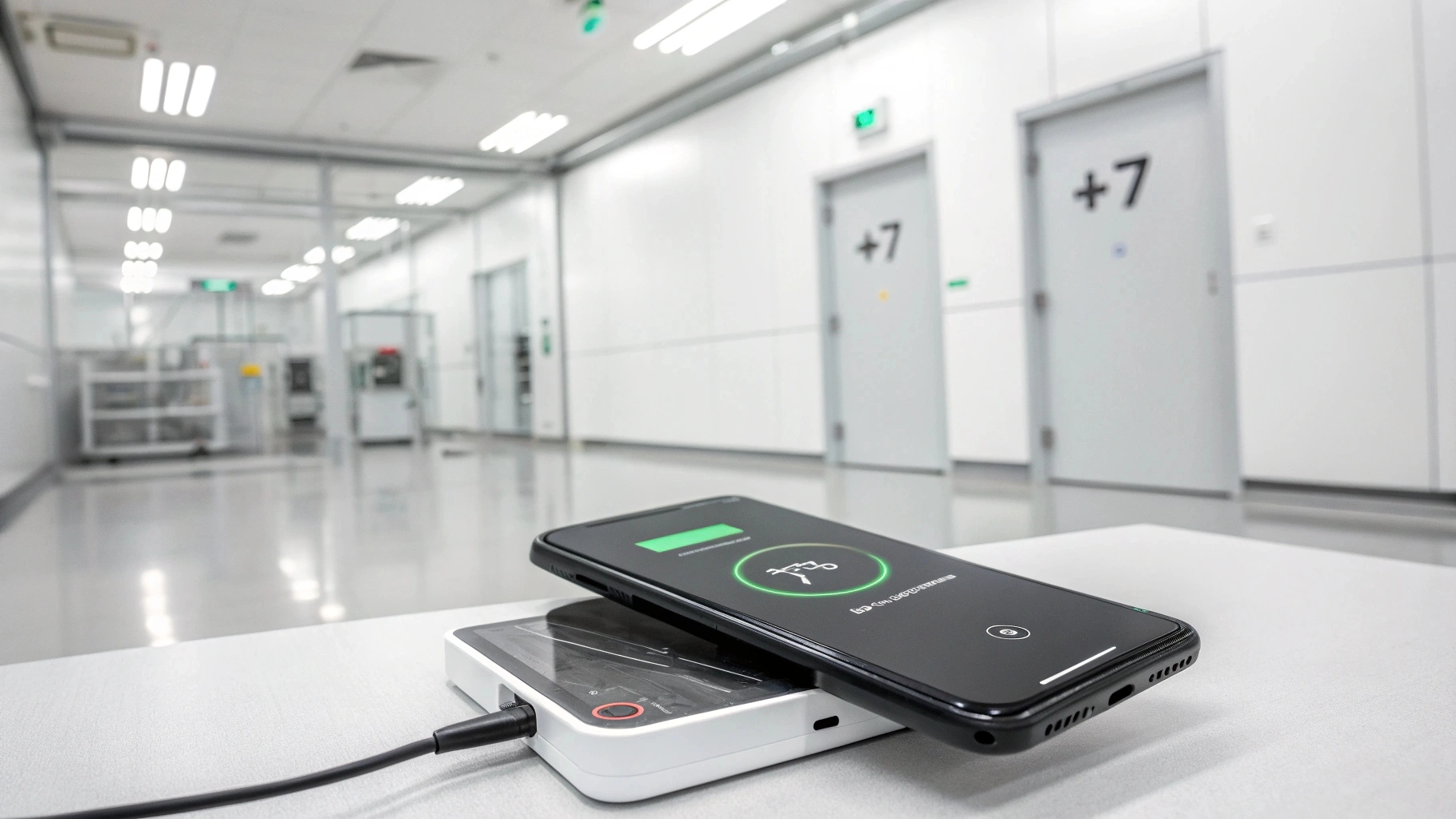

When we talk about charging a mobile phone, we usually just mean plugging it in before it reaches 0 % or unplugging it at 100 %. However, behind the choice of battery and charging method lies the manufacturer's thinking — conducting studies and even deciding on materials, software, and support. In this article, we will show you how mobile phone manufacturers think about batteries and then how you can follow the best path by charging your mobile phone correctly for health and longevity.
How the manufacturer thinks about mobile charging
Average mobile phone usage timeThe battery and the rest of the device are designed with the average user in mind: how long they will use it in a day. This means that the capacity is chosen so that it will last for approximately 24 hours.
Dimensions & design spacesBattery capacity depends on how much space is available inside the smartphone: thickness, size, battery unit location, other components. The company takes into account the dimensions that can be used by the inner and outer shells.
Materials & technologyBattery materials, cell layout, cooling, temperature management—all play a role. For more «economical» models, simpler internal materials will be used, as the expected battery life of the device is shorter. In contrast, for premium models that users keep for 3-5 years, the company invests in better materials.
Software and energy managementSoftware plays a key role: managing charging, heating, charging interruption at a certain percentage, control units (such as PMIC) that ensure charging remains within safe limits.
Cost & efficiencyEvery choice—larger battery, better materials, more sophisticated management—increases production costs. The company must balance cost with performance and set a final price that appeals to the right audience.
Optimal performance & support timeThe company wants the device to function satisfactorily throughout its entire lifespan—e.g., 3–5 years for the premium model. This means that the battery must be designed to maintain good capacity over a long period of time.
Turning point in real yield lossThe company predicts when the battery—due to charging and discharging cycles—will lose a significant percentage of its original capacity. The user's charging behavior affects this turning point.
With all of the above in mind, the company designs the battery so that it can cover one day's use under normal conditions. At the same time, it suggests to its users (indirectly or through instructions) what the ideal charging limits are.
Why mobile charging limits are important
Modern devices use lithium-ion (Li-ion) batteries — these degrade over time, mainly from many full charge cycles and high temperatures.
Experts agree that using the battery within the «sweet spot» charging range — approximately 20% to 80-90% — contributes to a longer battery life.
When we let the battery drop to 0% or charge it continuously to 100%, we increase the stress on the cells, especially if there is a high temperature at the same time — something that accelerates wear and tear.
Optimal charging path – the steps
- Charge your device when the battery drops to ~20-30 %.
- Try to disconnect it when it reaches ~80-90 %, without leaving it continuously at 100 %.
- Avoid using the device for heavy tasks (e.g., gaming, GPS) while charging, especially if the device is getting warm.
- Ensure that the device is located in a well-ventilated area, not under a pillow, and not in a car with very high temperatures.
- Use reliable cables and chargers, preferably those recommended by the manufacturer.
- If you prefer fast charging, use it occasionally — but don't make it a daily «norm» under conditions of high thermal load.
- If you leave the device charging for long periods of time (e.g., overnight), enable «optimized charging» (where available) in the settings so that it does not remain at 100% for too long.
Practical points and mistakes to avoid
- Do not charge the device from 0% to 100% every day — studies show that this accelerates battery wear.
- Do not leave your mobile phone charging overnight without supervision — prolonged static charging at 100% may lead to overheating.
- Avoid charging in the car at very high temperatures or with adapters of dubious quality.
- Check whether the device case is preventing heat dissipation — in some cases, removing it during charging helps.
- In everyday use, small charges (e.g., 40-80 %) are preferable to large full charges — this is referred to as «little and often.».
Charging a mobile phone is not simply a matter of «plugging it in» but a conscious choice — based on the manufacturer's thinking and the physiology of the battery. When we understand the parameters (dimensions, materials, software, cost, lifespan) that go into the design, we can work together as users to extend the life of our batteries.
In simple terms: we load inside the window 20-90 % (ideally 30-85 %), avoid extreme temperatures, use high-quality accessories, and don't leave your phone at 100% charge for hours. Investing in proper charging ensures that our device will respond during daily use — and remain healthy over time.